
Get Your Soil Tested
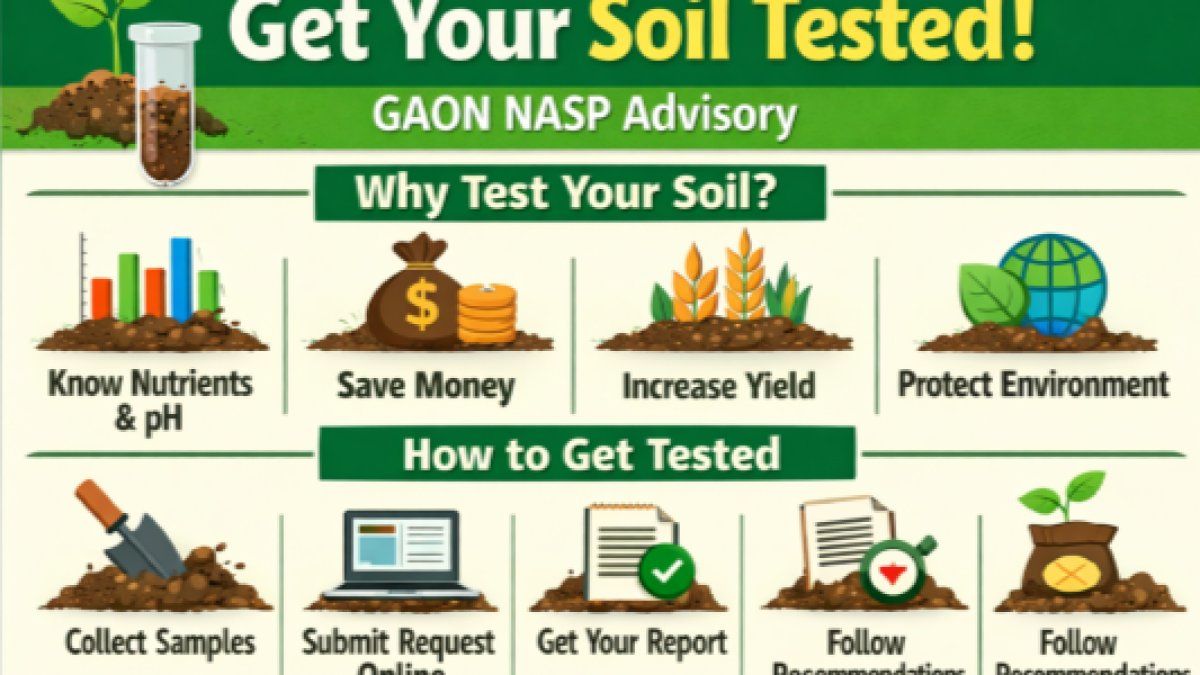
Get Your Soil Tested – GAON NASP Advisory
Healthy soil is the foundation of high crop productivity and sustainable farming. At GAON NASP, we strongly recommend that every farmer get their soil tested to make informed decisions about crop cycles, fertilizer application, and irrigation.
Why Soil Testing Matters
- Understand Soil Health: Know nutrient levels (N, P, K), pH, organic matter, micronutrients, and soil type.
- Save Money: Avoid unnecessary or excessive fertilizer use — apply only what your soil actually needs.
- Improve Yield & Quality: Balanced nutrition improves plant health, crop yield, and grain quality.
- Protect the Environment: Reduces nutrient runoff and prevents soil degradation.
Who Should Test Soil?
Every farmer — whether you are:
- Growing rice, wheat, pulses, vegetables, fruits, or cash crops
- Using a field for the first time
- Rotating crops or after a period of low yield
- Cultivating newly purchased or reclaimed land
When to Test
- Before the cropping season (ideal time)
- After heavy cropping, flooding, or continuous fertilizer use
- Every 2–3 years for regular crop planning
How Soil Testing Works
- Collect Soil Samples:
- Take 15–20 small samples from different parts of the field (5–15 cm depth).
- Mix them into one composite sample.
- Label & Submit:
- Note location, crop history, and recent fertilizer use.
- Contact your nearest GAON NASP center and submit an online request.
- Receive Your Report:
- The report provides nutrient levels, pH, and recommendations.
- Act on Recommendations:
- Apply fertilizers and soil amendments according to the report — not by guesswork.
How the Report Helps You Decide
- Correct dosage of Nitrogen (N), Phosphorus (P), Potassium (K)
- Requirement of micronutrients (Zn, B, Fe, etc.)
- Need for lime or gypsum based on pH
- Options to improve organic matter
Need Help Understanding Your Report?
At GAON NASP, we assist farmers in interpreting soil test reports and taking correct action.
Related Advisories
Get Your Soil Tested
Test your soil at the nearest KVK or soil testing lab. It costs only ₹10-50 and helps you save on fe...
Get Your Soil Tested
Test your soil at the nearest KVK or soil testing lab. It costs only ₹10-50 and helps you save on fe...
Kharif Pest Alert — Monitor crops
Watch for stem borer, leaf folder in rice. Apply Cartap Hydrochloride if needed. Contact KVK for gui...
Kharif Pest Alert — Monitor crops
Watch for stem borer, leaf folder in rice. Apply Cartap Hydrochloride if needed. Contact KVK for gui...