GAON NASP 100+5 Goat Farming Model: A Sustainable Path to Rural Entrepreneurship and Income Generation
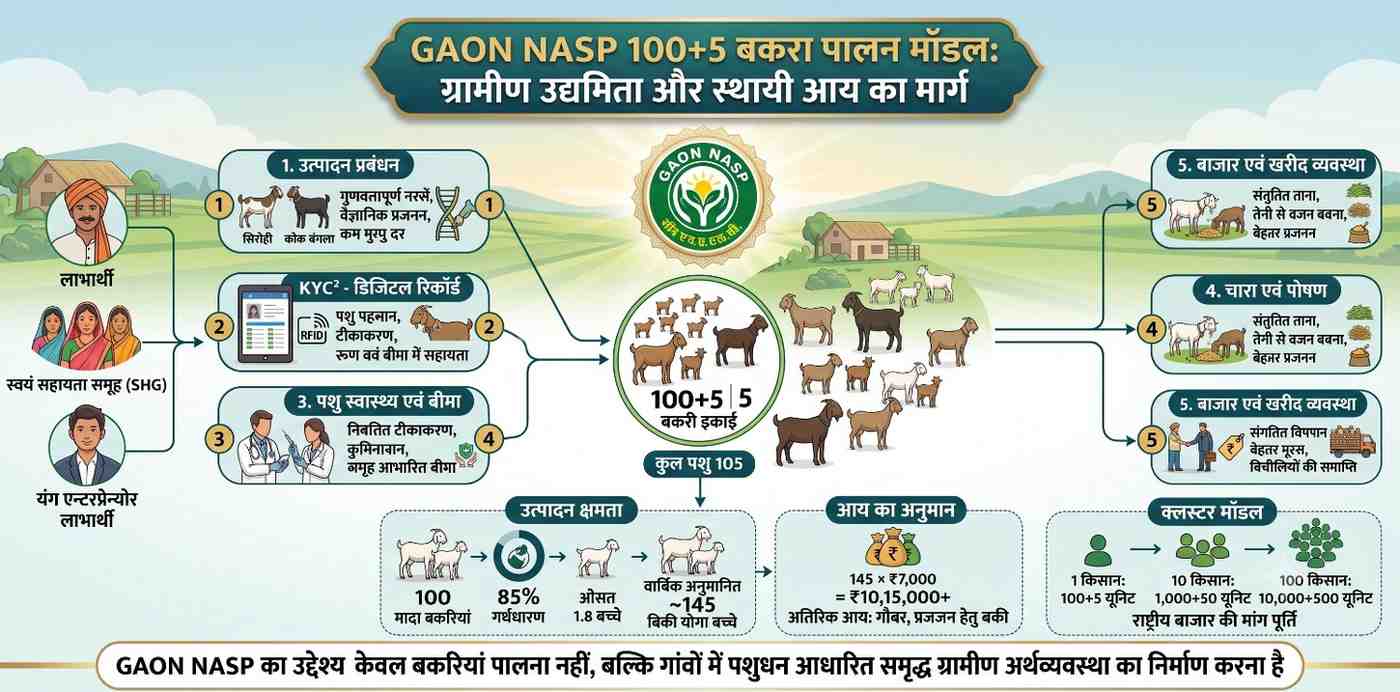
The GAON NASP 100+5 Goat Farming Model transforms traditional goat rearing into a profitable rural enterprise. With 100 breeding does and 5 bucks, the model integrates scientific livestock management, KYC² digital animal identification, veterinary care, insurance, finance, and market linkages. By organizing farmers into village-level livestock clusters, GAON NASP helps improve productivity, reduce risks, increase incomes, and create sustainable rural livelihoods.
Introduction
Goat farming has long been an important source of livelihood for rural families across India. Due to its low investment requirement, minimal land needs, rapid reproduction cycle, and growing demand for goat meat, goat farming has emerged as one of the most profitable livestock enterprises for small and marginal farmers.
To transform traditional goat rearing into a scalable rural enterprise, GAON NASP (Grassroot Agriculture Organized Network through National Animal Sustainability Platform) has developed the 100+5 Goat Farming Model. This model goes beyond livestock production by integrating animal health, digital identity, finance, insurance, and market linkages into a comprehensive rural business ecosystem.
What is the 100+5 Goat Farming Model?
The model consists of:
| Particulars | Number |
|---|---|
| Female Goats (Does) | 100 |
| Breeding Bucks | 5 |
| Total Animals | 105 |
This commercial-scale unit is designed for progressive farmers, rural entrepreneurs, Farmer Producer Organizations (FPOs), Self-Help Groups (SHGs), and livestock cooperatives.
Why is the GAON NASP Model Different?
In conventional goat farming, farmers typically purchase animals, manage production, and sell through local traders. The GAON NASP model addresses key challenges by creating an organized ecosystem that supports farmers throughout the value chain.
The Five Pillars of the GAON NASP Goat Farming Model
1. Scientific Production System
The model promotes:
-
Selection of quality breeds
-
Scientific breeding management
-
Improved kidding rates
-
Reduced mortality
-
Faster weight gain
Recommended breeds include:
-
Sirohi
-
Black Bengal
-
Jamunapari
-
Barbari
-
Beetal
-
Osmanabadi
The focus is on maximizing productivity while maintaining animal welfare and sustainability.
2. KYC² – Know Your Cattle
A unique feature of GAON NASP is the creation of a digital identity for every animal.
Each goat is registered with:
-
Breed information
-
Age records
-
Ownership details
-
Vaccination history
-
Health records
-
Production performance
This digital livestock profiling enhances traceability, improves credibility, and creates opportunities for livestock financing and insurance.
3. Animal Health and Insurance
Animal health is critical for profitability in commercial goat farming.
Under the GAON NASP framework:
-
Regular vaccination schedules are followed
-
Deworming programs are implemented
-
Veterinary consultation is facilitated
-
Group insurance coverage is encouraged
-
Disease-related losses are minimized
This systematic approach significantly reduces mortality and improves herd performance.
4. Feed and Nutrition Management
Nutrition directly influences growth, reproduction, and profitability.
The model promotes:
-
Green fodder cultivation
-
Dry fodder utilization
-
Balanced concentrate feeding
-
Mineral supplementation
-
Efficient feed resource management
Proper nutrition improves weight gain, reproductive efficiency, and disease resistance.
5. Market Linkages and Buyback Ecosystem
One of the biggest challenges faced by goat farmers is accessing reliable markets.
GAON NASP addresses this through:
-
Cluster-based production systems
-
Aggregation of livestock
-
Linkages with bulk buyers
-
Organized marketing channels
-
Improved price realization
This helps farmers reduce dependence on middlemen and access larger, more profitable markets.
Production Potential of a 100+5 Unit
Assumptions:
-
Conception Rate: 85%
-
Average Kids per Doe: 1.8
Annual Kid Production:
100 Does × 85% × 1.8 = 153 Kids
Using conservative estimates, a farmer can expect approximately 140–150 marketable kids per year.
Income Illustration
If 145 kids are sold annually at an average price of ₹7,000 per kid:
145 × ₹7,000 = ₹10,15,000
Additional income opportunities include:
-
Manure sales
-
Breeding buck sales
-
Organic fertilizer production
-
Demonstration and training services
As herd productivity improves, annual revenue can increase substantially.
Cost Components
Major operational expenses include:
-
Purchase of breeding stock
-
Feed and fodder
-
Veterinary care
-
Vaccination and deworming
-
Insurance
-
Labor and farm management
With proper planning and scientific management, the model can generate sustainable annual profits while continuously expanding herd value.
The GAON NASP Cluster Approach
GAON NASP is not merely a farm-level intervention; it is a village-level livestock development ecosystem.
Example of Scale
| Farmers | Goat Population |
|---|---|
| 1 Farmer | 100+5 |
| 10 Farmers | 1,000+50 |
| 100 Farmers | 10,000+500 |
This aggregation model creates economies of scale, attracts institutional buyers, and strengthens rural value chains.
Rural Employment and Social Impact
The 100+5 Goat Farming Model contributes to:
-
Rural employment generation
-
Women’s economic participation
-
Youth entrepreneurship
-
Diversified farm income
-
Organic manure production
-
Livestock-based wealth creation
The model supports both economic growth and social development in rural communities.
Key Success Factors
-
Procure healthy and quality breeding stock.
-
Maintain proper housing and hygiene.
-
Follow regular vaccination schedules.
-
Ensure balanced nutrition.
-
Maintain animal records and performance data.
-
Insure livestock assets.
-
Participate in organized networks such as GAON NASP.
Vision of GAON NASP
GAON NASP envisions creating a nationwide network of livestock-based rural enterprises by integrating:
-
Production
-
Digital Livestock Identity
-
Animal Health
-
Insurance
-
Finance
-
Market Access
-
Rural Entrepreneurship
The goal is to transform farmers from livestock keepers into successful rural business owners.
Conclusion
The GAON NASP 100+5 Goat Farming Model is more than a livestock project—it is a scalable rural enterprise framework designed to enhance farmer incomes, create employment, and build resilient village economies.
By combining scientific goat farming practices with digital innovation, financial inclusion, and market integration, the model offers a practical pathway toward sustainable rural prosperity.
Comments 0
No comments yet. Be the first!
Leave a Comment