
How Does the GAON NASP Cluster Model Increase Farmers’ Income?
The GAON NASP cluster model helps farmers increase income by organizing them into groups, enabling better prices, reducing costs, and providing direct market access through data-driven farming.
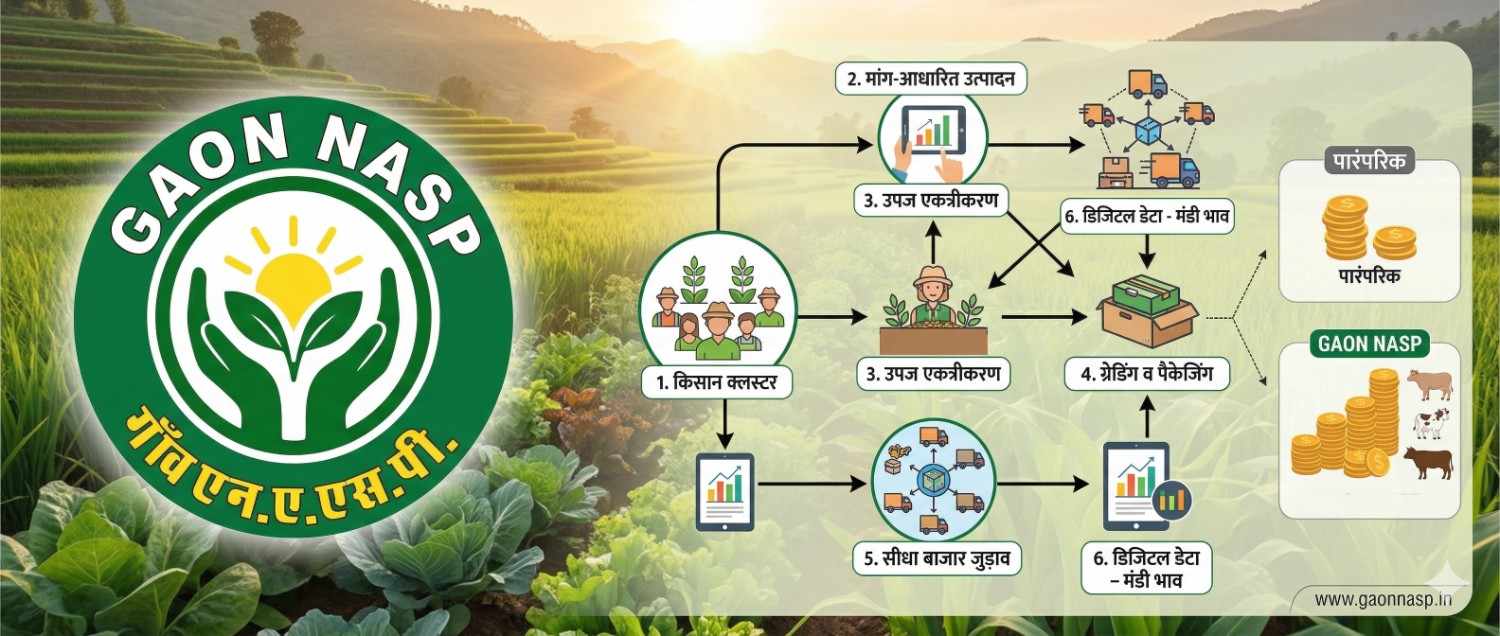
In India, most farmers are small and marginal. They work hard, but due to low production, fragmented selling, and limited market access, they often do not get the right price for their produce.
This is where the GAON NASP Cluster Model brings a new direction to agriculture—where farmers do not work alone, but as part of a strong and organized network.
Where is the Problem?
The main reasons for low farmer income are:
- Small-scale production
- Unorganized and individual selling
- Dependence on middlemen
- Lack of accurate market information
- Weak supply chain and logistics
The solution to all these problems lies in one word—organization.
What is Special About the GAON NASP Cluster Model?
GAON NASP does not just connect farmers—it transforms them into a structured system.
In this model, every village becomes a mini agri-network, where:
- Farmers are connected
- Data is available
- Direct market access is ensured
How Does This Model Work? (Ground-Level Process)
1. Farmer → Cluster → Network
GAON NASP organizes farmers at the village level into clusters.
Each cluster becomes a strong and organized unit.
2. Demand-Based Farming
In the cluster, farmers decide which crop to grow based on market demand and prices.
This shifts farming from “grow and sell” to “plan and sell smartly.”
3. Aggregation (Strength in Volume)
All farmers’ produce is collected at one place.
Small quantities → Converted into large volume
This is the biggest transformation.
4. Direct Market Linkage
With larger volumes:
- Big buyers connect directly with clusters
- Farmers receive better prices
5. Supply Chain Management
GAON NASP ensures organized movement of produce from farm to market:
- Collection
- Grading
- Packaging
- Transportation
Everything is streamlined.
6. Digital Data and Decision-Making
Farmers get access to:
- Real-time mandi prices
- Market demand insights
- Production data
This transforms farming from guesswork to data-driven decision-making.
The Real Economics Behind Income Growth
1. Quantity Advantage
Higher volume = Bigger buyers = Better prices
2. Cost Reduction
- Collective buying → Cheaper seeds and fertilizers
- Shared resources → Lower costs
3. Price Discovery
Digital information helps farmers decide where and when to sell.
4. Value Addition
Grading, packaging, and processing increase product value.
5. Risk Diversification
- Multiple crops
- Integration of livestock
→ Multiple income streams
GAON NASP Model vs Traditional Farming
| Aspect | Traditional Farming | GAON NASP Cluster Model |
| Production | Small & scattered | Large & organized |
| Selling | Individual | Collective |
| Market Access | Limited | Wider & direct |
| Pricing | Lower | Better |
| Risk | High | Lower |
| Information | Limited | Real-time |
A Real Example
Suppose 40 farmers grow okra.
Earlier:
- Sold individually
- Dependent on local traders
- Lower prices
With GAON NASP:
- Formed a cluster
- Combined produce
- Direct deal with large buyers
- Achieved 15–20% better prices
- The Biggest Transformation for Farmers
The GAON NASP cluster model transforms farmers:
- From producers to agri-entrepreneurs
- From individuals to part of a network
- From uncertain income to stable income
Conclusion
The GAON NASP cluster model does not just change the way farming is done—it transforms farmers’ thinking, strategy, and income.
- When farmers are connected, their strength increases.
- When data is available, decisions improve.
- When markets are accessible, income grows.
What Should You Do?
If you want to increase your income:
- Join GAON NASP
- Form or join a village cluster
- Adopt collective farming
- Use digital information
- Connect directly with markets
A smart farmer today is not one who works alone, but one who works with a network.
Join GAON NASP and turn your farming into a strong and profitable enterprise.
Comments 0
No comments yet. Be the first!
Leave a Comment