Individual Farming vs Collective Farming: Which is More Profitable? (With GAON NASP Model)
Collective farming, especially with the GAON NASP model, helps farmers reduce costs, access better markets, and earn higher income compared to individual farming.
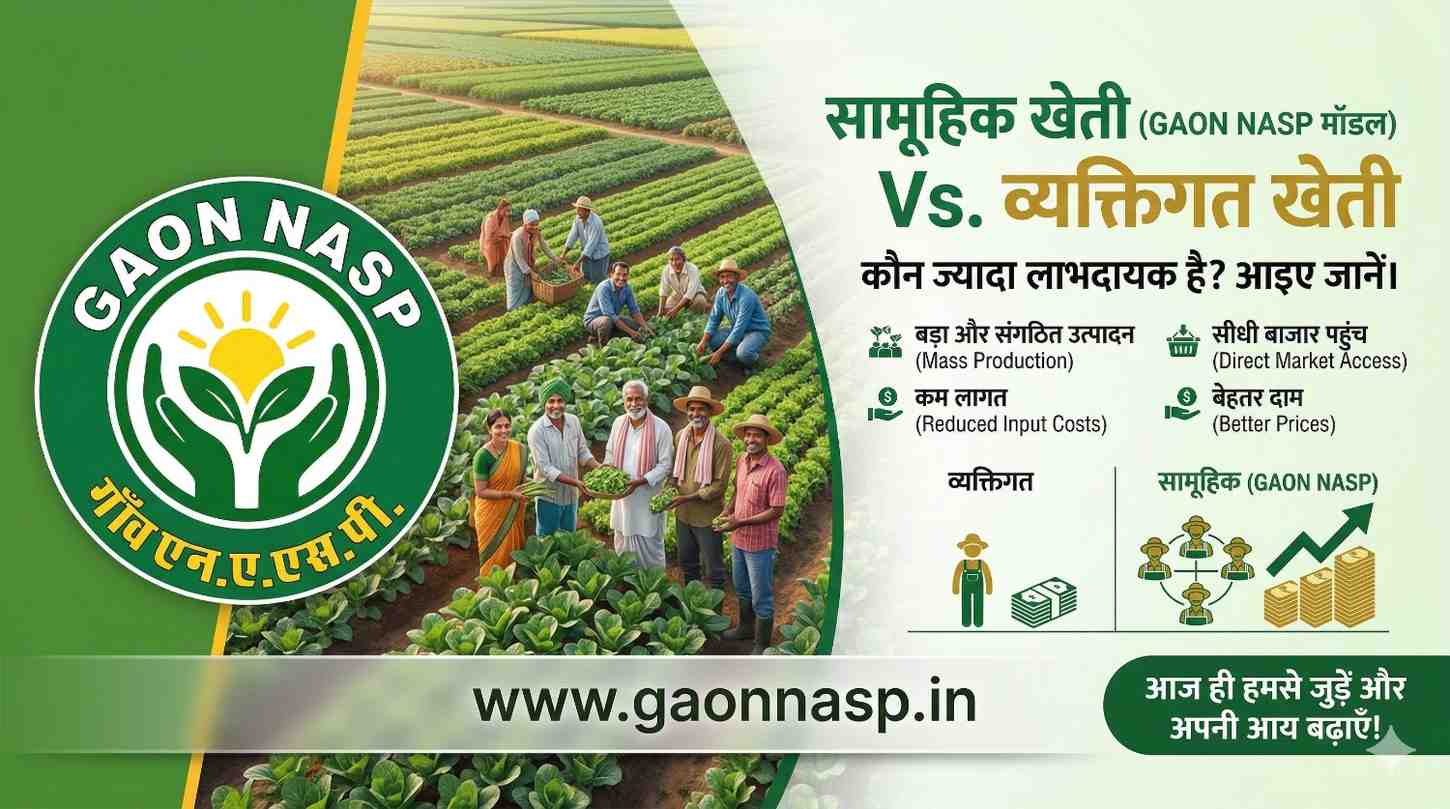
For a long time in India, farmers have practiced individual farming, where each farmer works independently. However, with rising costs, market competition, and limited access to buyers, this model is becoming less profitable.
Today, collective farming (cluster-based farming) is emerging as a more effective and profitable approach—especially when supported by the GAON NASP model.
What is Individual Farming?
In individual farming, a farmer:
- Works alone
- Manages production and sales independently
- Operates on a small scale
Challenges:
- Low production volume
- Weak bargaining power
- Limited market access
- Dependence on middlemen
- Higher input costs
What is Collective Farming?
In collective farming, a group of farmers:
- Grow crops together (or in coordination)
- Plan production collectively
- Sell their produce in bulk
This model is often implemented through clusters or farmer groups.
Key Differences
| Aspect | Individual Farming | Collective Farming (GAON NASP Model) |
|---|---|---|
| Production | Small & scattered | Large & organized |
| Cost | High | Lower (bulk purchasing) |
| Selling | Individual | Collective |
| Market Access | Limited | Direct & wider |
| Price | Lower | Better |
| Risk | High | Lower |
| Information | Limited | Real-time |
Which is More Profitable?
1. Better Prices
Collective farming enables bulk selling, which attracts bigger buyers and ensures better prices.
2. Lower Costs
Farmers can reduce costs by purchasing inputs like seeds and fertilizers in bulk.
3. Improved Market Access
Individual farmers struggle to reach large markets, while groups can connect directly with buyers.
4. Risk Management
Working in a group reduces individual risk and improves stability.
5. Better Decision-Making
With GAON NASP, farmers get real-time data, helping them make smarter decisions.
How GAON NASP Strengthens Collective Farming
- Organizes farmers into village-level clusters
- Provides real-time mandi price and market information
- Connects farmers directly with buyers
- Supports supply chain and logistics
- Enables access to finance and services
Example
Suppose 25 farmers grow crops individually:
Individual Farming:
- Separate selling
- Low volume
- Lower prices
With GAON NASP Collective Model:
- Group production
- High volume
- Direct buyers
- 10–20% higher prices
Conclusion
- In individual farming, a farmer works alone.
- In collective farming, a farmer becomes part of a strong network.
In today’s market-driven agriculture, it is clear that:
Collective farming (with the GAON NASP model) is more profitable, stable, and sustainable.
What Should You Do?
- Connect with farmers in your village
- Form or join a cluster
- Join GAON NASP
- Adopt collective production and selling
A successful farmer today is not the one who works alone, but the one who works with a network.
Join GAON NASP and take your farming income to the next level.
Comments 0
No comments yet. Be the first!
Leave a Comment