What is Cluster Farming and How Does It Work?
Cluster farming helps farmers work together, increase production, reduce costs, and get better prices. Learn how GAON NASP enables farmers to adopt this model and access markets efficiently.
In today’s agriculture, small and scattered farming often does not give farmers the desired profit.
A powerful solution to this problem is Cluster Farming.
What is Cluster Farming?
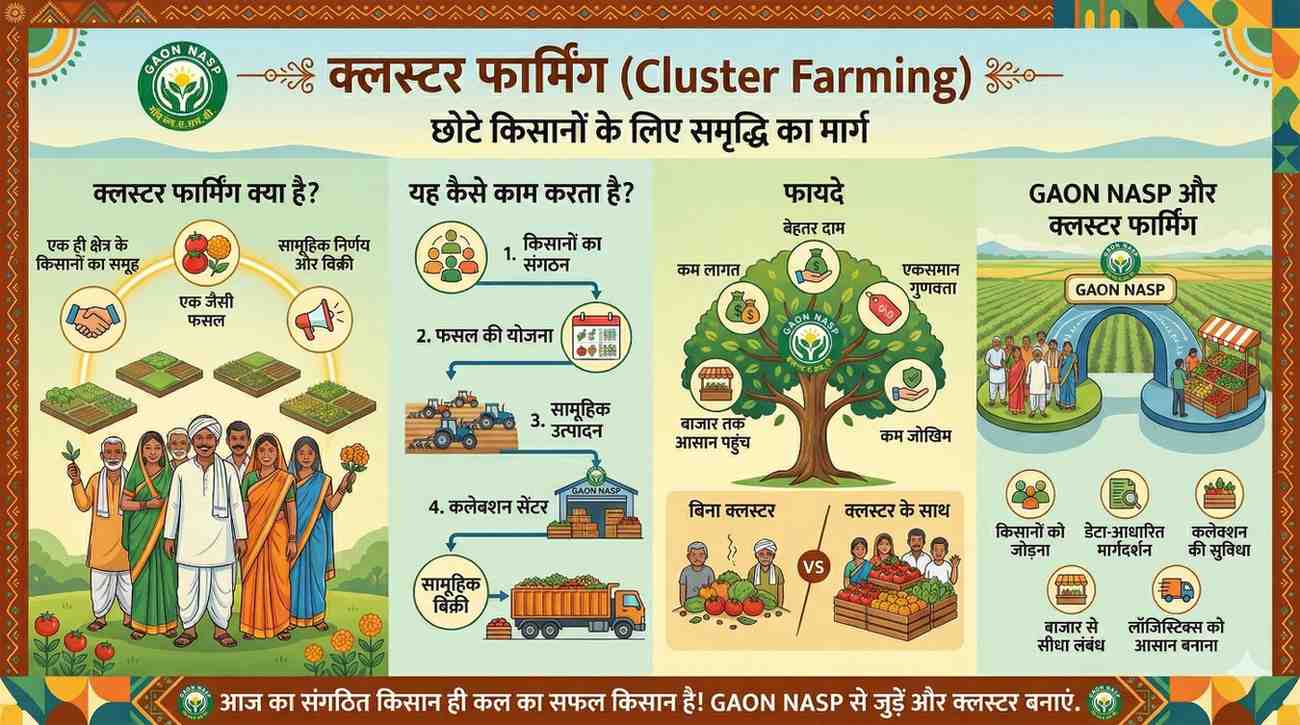
Cluster farming means a group of farmers from the same village or area working together in a coordinated way.
In this model, farmers keep their land separate, but:
- Grow similar crops
- Plan together
- Sell their produce collectively
Simple Example
Suppose there are 20 farmers in a village.
If each farmer grows and sells individually:
- Small quantity
- Lower price
But if all farmers grow the same crop and sell together:
- Larger quantity
- Direct buyers
- Better price
How Does Cluster Farming Work?
1. Formation of Farmer Groups
Farmers from the same village or nearby area are organized into a cluster.
2. Crop Planning
Farmers collectively decide which crop to grow and how to manage it.
3. Collective Production
Farmers follow similar practices to ensure better quality and uniform produce.
4. Collection and Aggregation
Produce is collected at a central point, creating a large volume for sale.
5. Collective Selling
Large quantities attract bigger buyers, leading to better prices and direct market linkage.
Benefits of Cluster Farming
1. Better Price Realization
Higher quantity increases bargaining power.
2. Reduced Cost
Bulk purchase of seeds, fertilizers, and inputs reduces expenses.
3. Easy Market Access
Large buyers and companies prefer buying in bulk from organized groups.
4. Improved Quality
Uniform farming practices lead to consistent quality.
5. Reduced Risk
Shared planning and information reduce farming risks.
Role of GAON NASP in Cluster Farming
GAON NASP brings cluster farming into action at the grassroots level.
What GAON NASP Does:
- Organizes farmers into village-level clusters
- Provides crop planning and data-based guidance
- Enables collection and aggregation systems
- Connects farmers directly with buyers and markets
- Supports supply chain and logistics
Example
If 50 farmers grow tomatoes together:
Without Cluster Farming:
Small volume → Lower price
With Cluster Farming:
Large volume → Better price + Direct market access
Conclusion
Cluster farming is a strong opportunity for small and marginal farmers.
It helps them become organized, increases their bargaining power, and improves income.
By joining platforms like GAON NASP and adopting cluster farming, farmers can make agriculture more profitable and sustainable.
What Should You Do?
- Connect with farmers in your village
- Form a cluster
- Plan crops collectively
- Join GAON NASP for better market access
An organized farmer is a successful farmer.
Comments 0
No comments yet. Be the first!
Leave a Comment