
Indian Agriculture in a Changing Climate: Farmers Must Lead the Change
Indian agriculture is facing growing challenges from climate change, including erratic rainfall, extreme temperatures, floods, and droughts. To remain profitable and sustainable, farmers must move beyond traditional rice and wheat cultivation and embrace climate-resilient crops, integrated dairy farming, and export-oriented agricultural opportunities. The future belongs to farmers who adapt, innovate, and lead the change.
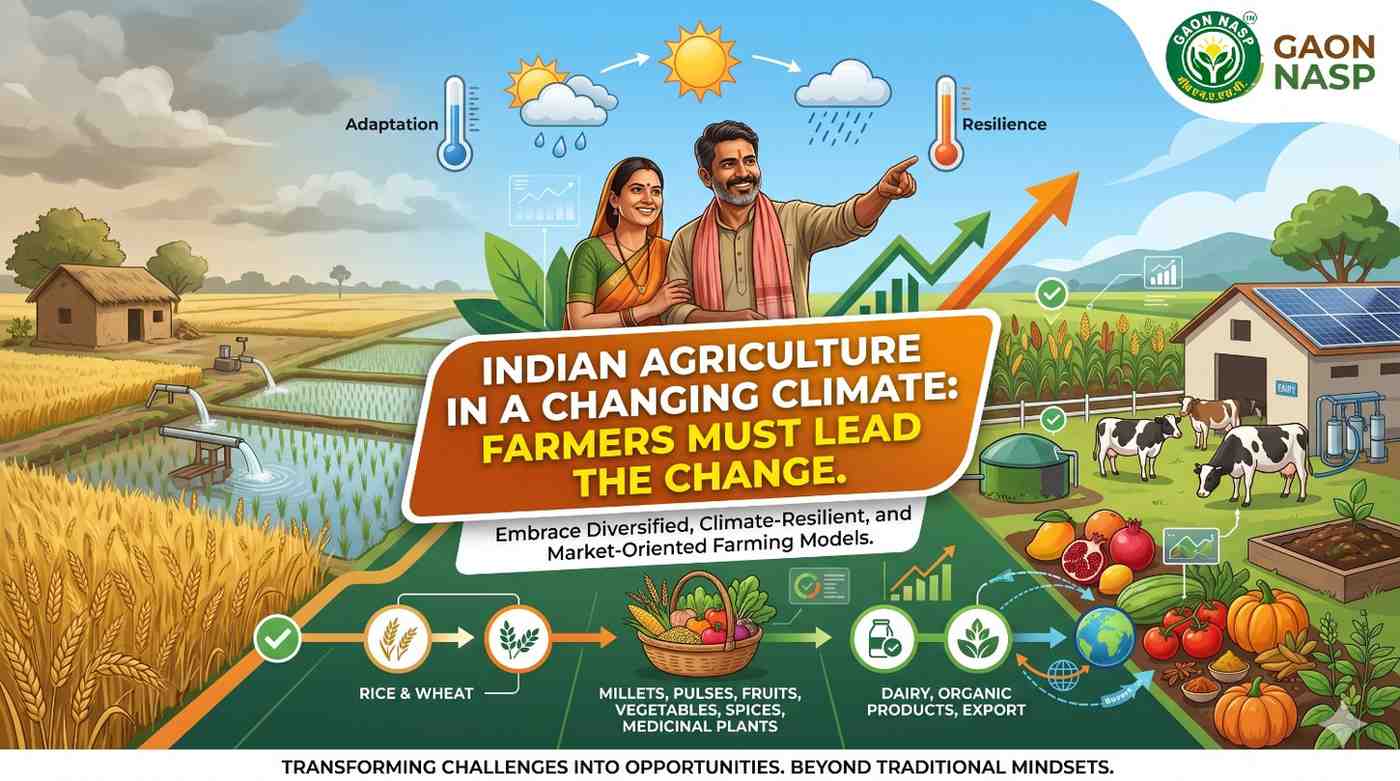
Indian agriculture is entering a period of unprecedented uncertainty. Low rainfall, unseasonal heavy rains, floods, droughts, heat waves, and rising temperatures are increasingly affecting farm productivity and rural livelihoods. Climate scientists continue to warn that extreme weather events may become more frequent and intense in the coming years. In such a scenario, relying solely on traditional rice and wheat cultivation is becoming increasingly risky for millions of farmers across the country.
The time has come for Indian farmers to rethink their agricultural strategies and adapt to the realities of climate change. Crops that require less water and can withstand higher temperatures must become part of the future farming landscape. Millets, pulses, oilseeds, spices, medicinal plants, fruits, and vegetables offer promising alternatives that can provide better income while reducing climate-related risks.
At the same time, agriculture should not remain limited to crop production alone. An integrated dairy-based farming model can provide greater resilience and sustainability. Livestock rearing, organic manure production, biogas generation, fodder cultivation, and crop farming can complement each other and create multiple sources of income for rural households. When one source of income is affected, another can provide stability and support.
Global demand for agricultural products is changing rapidly. Export-oriented farming presents a significant opportunity for Indian farmers. Products such as spices, honey, fruits, vegetables, dairy products, medicinal plants, organic produce, and value-added agricultural products have growing demand in international markets. By focusing on quality standards, traceability, collective production, processing, and market linkages, Indian farmers can capture a larger share of the global agricultural economy.
However, the most important question remains:
Who will bring this change?
Will it be the government alone?
Will it be institutions alone?
Will it be schemes and subsidies alone?
The reality is that governments can create policies, provide support, and facilitate opportunities, but they cannot replace the farmer's vision and decision-making. The most important investment for the future is not only financial—it is the willingness to adopt new ideas, new technologies, and new markets.
Whether it is a Super El Niño, excessive rainfall, floods, droughts, or prolonged heat waves, climatic conditions will continue to change. Climate change will not wait for anyone. Therefore, farmers must also evolve. Those who adapt their crop choices, water management practices, production systems, and market strategies will be the ones who thrive in the years ahead.
This is not the time for complaints; it is the time for preparation. Government support is important, but farmers should not leave the future of their farms entirely in the hands of external agencies. In a rapidly changing world, self-reliant and adaptive farmers will be the strongest farmers.
The challenges before Indian farmers are significant, but so are the opportunities. The choice is ours: we can either become victims of changing circumstances or leaders of agricultural transformation.
The future belongs to farming systems that use less water, tolerate higher temperatures, respond to market demand, leverage export opportunities, and provide sustainable incomes to farming families.
It is time to move beyond the traditional rice-and-wheat mindset and embrace climate-resilient, market-oriented, diversified, and integrated farming models. The farmer of the future will not simply be a producer of crops but an entrepreneur managing agriculture, dairy, natural resources, and market opportunities together.
The future of Indian agriculture will not be decided by climate change alone—it will be decided by how quickly farmers adapt to it.
Written By:
Nitee Ranjan Pratap
Founder, GAON NASP
Comments 0
No comments yet. Be the first!
Leave a Comment